
Clienteling, plainly explained.
Clienteling is the retail practice of serving each client as a named, continuing relationship rather than a transaction: knowing what they own and like, reaching out with a reason, and recording what happened so the next conversation starts where the last one stopped.
What is clienteling?
What it is
A lasting relationship between a client and a dedicated advisor, built on everything known about the client and carried from one visit to the next, in store and remotely.
What it is not
Neither mass emailing nor a loyalty card. Clienteling addresses one client at a time, with a reason to reach out and a person signing the message.
Where the word comes from
From Anglo-Saxon luxury retail. Long before anything was digital, every advisor already kept a client book, a notebook where they wrote down everything about their clients. It was their main working tool.
Who practises it
Luxury houses and premium networks, but also independent jewellers, watchmakers and fashion boutiques: wherever baskets are high and visits infrequent.
Is clienteling a word? Spelling and pronunciation.
How to pronounce it
Klee-en-TELL-ing, with the stress on the third syllable. It is built from clientele, the body of clients a house serves, and follows the same pattern as retailing or wholesaling.
Clienteling, clientelling or clienting?
Clienteling is the standard spelling in trade press and job titles. Clientelling, with two l's, appears in British usage. Clienting is a shorthand heard on the floor. All three name the same practice.
The closest synonyms
Relationship selling, one-to-one retail, client book selling, personal shopping. Each covers a part of it. Only clienteling covers the whole: knowing a client, reaching out with a reason, and recording what happened.
Not to be confused with
Customer service handles a request that has already been made. Clienteling starts the conversation before the client asks, and continues it between visits.
What clienteling looks like on the shop floor.
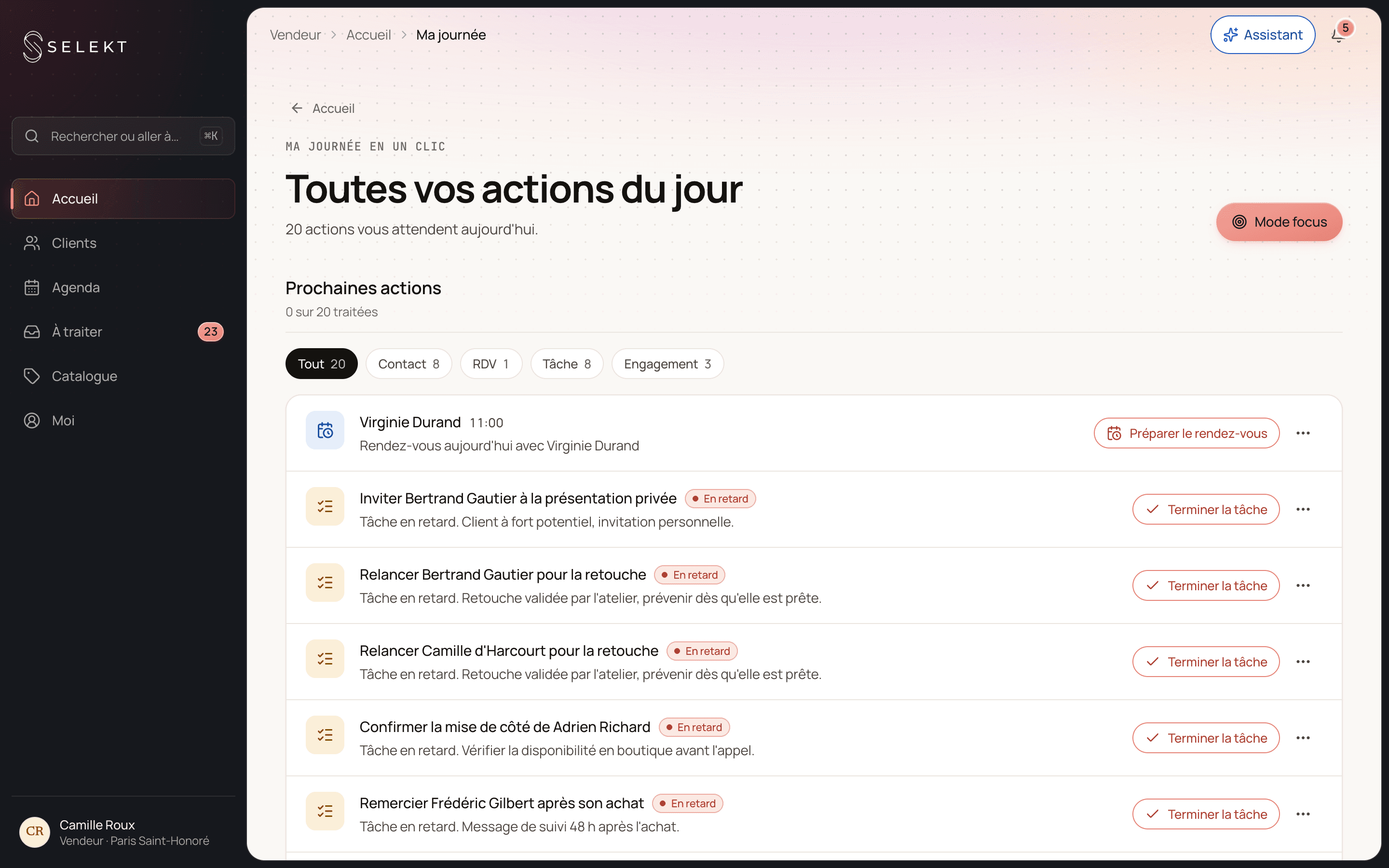
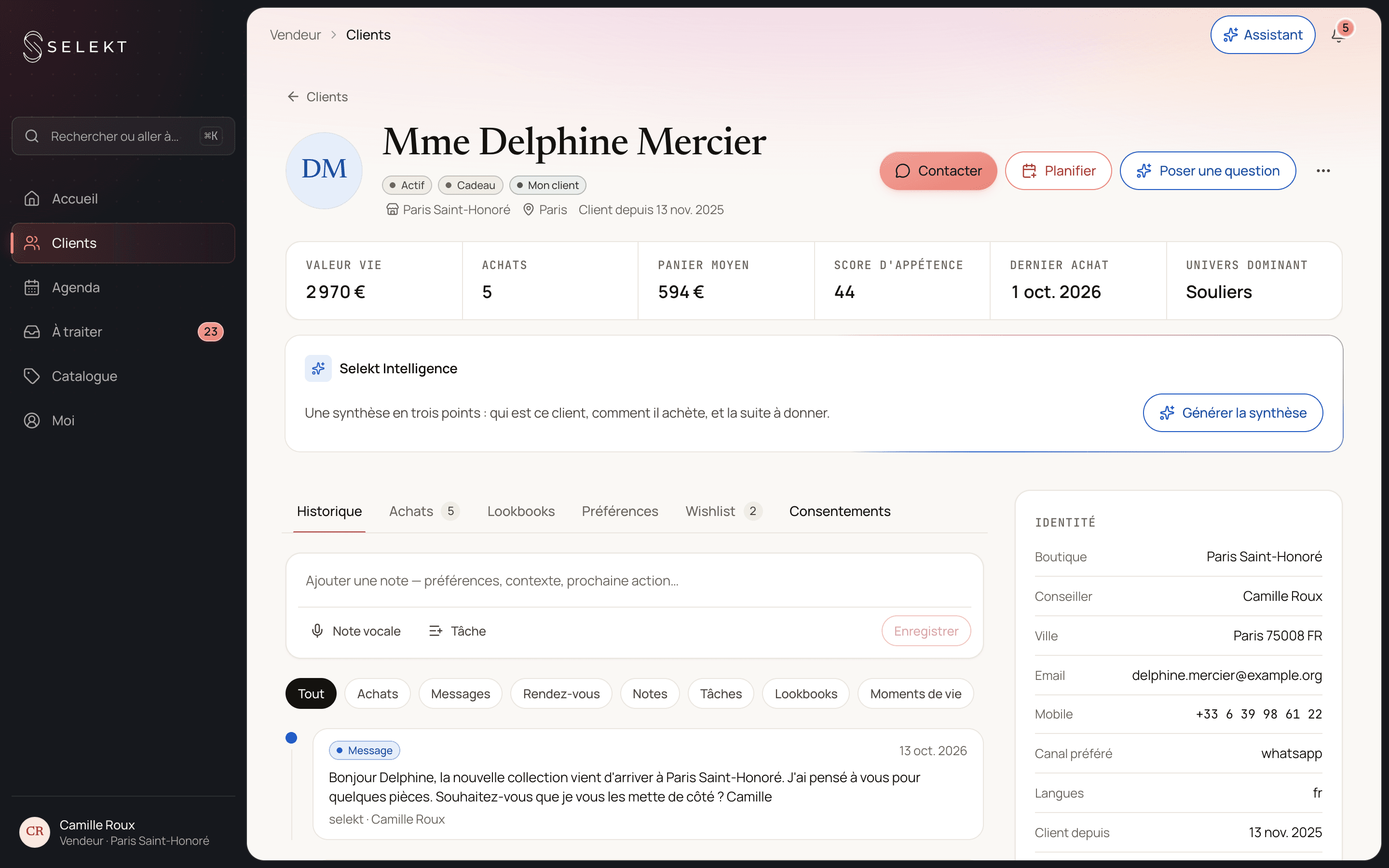
Clienteling is not a concept: it is a series of concrete gestures, made by an advisor between two clients. Across a day, it amounts to a few well-spent minutes — which is exactly why the tool has to answer in seconds.
- In the morning, the list of clients to contact: birthdays, orders received, pieces set aside
- After a sale, the client profile completed: what appealed, what was tried, what to show next time
- When a piece arrives in store, a client on the waitlist or who showed interest in it is messaged and an appointment is booked
- In the evening, what did not land is carried forward, not forgotten
Five clienteling examples.
The piece set aside
A client hesitates over a bracelet. It goes on her wishlist. Three weeks later the advisor tells her one is left: the sale closes without a discount.
The anniversary of a milestone purchase
A client bought a watch for an occasion. A year later, a message signed by the advisor who sold it, sent at the right moment, is worth more than ten campaigns.
The predictable replacement
Some products are replaced on a known cycle. Clienteling means being there a month before, not six months after.
The piece found elsewhere in the network
The size is out of stock here, but available three streets away. The advisor sees it, offers it, and the sale stays within the house.
The client is reassigned, not lost
An advisor leaves. Their clients remain known to the house: history, preferences, conversations. The relationship is transferred instead of walking out of the door.
Clienteling vs CRM: what is the difference?
| General-purpose CRM | Selekt | |
|---|---|---|
| Primary user | Marketing, headquarters | Advisor on the shop floor |
| Unit of work | A segment, a campaign | A client, a conversation |
| Where it is used | Desk, computer | Shop floor, mobile |
| Messages signed by | The brand | The advisor who knows the client |
| Expected measure | Open and click rates | Sales attributed to actions |
| Time available to use it | A working session | Two minutes between clients |
The two coexist well: the CRM keeps the overall view, clienteling carries the individual relationship and returns the evidence of what it produced.
How a CRM and clienteling work together.
Who writes what
The CRM owns campaigns, segments and bulk consent. Clienteling owns individual actions and what the advisor learns on the floor. Any field both sides can edit needs a declared owner.
One client, two databases
The same person exists on both sides, often under a different email. Identity is reconciled once, on a stable identifier — otherwise the same client is addressed twice, with two messages that contradict each other.
Consent follows the client, not the tool
An opt-out recorded in the CRM has to stop individual outreach as well. It is the rule most often forgotten when two tools write to the same base.
A sale is counted once
If the campaign and the advisor both claim the same sale, nobody believes the figures any more. Attribution has to say which one wins, and under which rule.
What is clienteling in luxury retail?
The same practice, with longer cycles and higher baskets. A client may visit once or twice a year, so the record matters more than footfall: pieces tried, sizes, occasions ahead, the name of the person who served them last time.
- The relationship belongs to the house, not only to the advisor who built it
- Discretion is part of the service: no mass sends, no promotional tone
- Appointments, private viewings and waiting lists carry more weight than campaigns
- One client is often served in several cities, and must be recognised in each
How to measure clienteling.
01
Trace the action
A message, an appointment, a follow-up: the action is timestamped and attributed to its author. Without that trace, nothing can be measured later.
02
Set the attribution window
How long after a contact is a sale attributable to it? Seven, thirty, ninety days: that is the house's decision, written down, not a hidden setting.
03
Attribute the sale
When the client buys within that window, the sale joins influenced revenue. It stays separate from walk-in sales and is never added to them: a sale counted twice discredits the whole measure.
04
Reconcile
Store by store, line by line, leadership and the floor read the same figures. That is what gives the results their full weight. And the stakes are real: at equipped retailers, revenue influenced by clienteling often reaches 20 to 25 percent of the total.
What a clienteling platform should include.
Criteria rather than brands. Each one corresponds to a way projects fail when it is missing.
Why clienteling programmes fail.
The causes are almost always the same, and none of them is technical.
The tool asks more than it gives
If filling in a profile takes longer than the service it renders, advisors will not do it. The return has to be immediate: find a client, see stock, send a clean message.
The data lives elsewhere
If purchases stay in the POS and preferences in a notebook, nobody sees the whole client. Clienteling assumes data flows both ways with the tools already in place.
Nobody measures
Without attribution, clienteling remains an intuition, and the first budget review kills it. Houses that keep going are those that can say what the relationship produced.
Management does not follow
A manager who never looks at clienteling actions tells the team plainly that it does not count. The opposite is true as well.
Clienteling across a store network.
One client, several stores
The same person buys in two cities. Without a shared client record, two advisors work the same relationship in parallel, and both claim the sale.
Sharing out the client book
Who follows whom is a decision, not an accident. Portfolios are assigned, visible, and reviewed — otherwise the best clients are followed twice and the rest not at all.
When an advisor leaves
Their portfolio is reassigned with its history. The house keeps the relationship it paid to build, and the client is not greeted as a stranger.
The same definition everywhere
One attribution window, one set of included channels, one client record. Local variations make network figures impossible to compare.
Clienteling by sector.
The gestures are the same; the moments differ.
Clienteling and client data.
Consent, recorded
Who agreed to be contacted, on which channel, and when. Consent is part of the client record, not a spreadsheet kept next to it.
Permissions at data level
An advisor sees their clients, a manager their store, headquarters the network. Sensitive fields can be restricted further, by role and by store.
An audit log
Every access and every change is recorded. It protects the house, and it settles disputes over who did what.
Data that stays yours
Client records, conversations and action history belong to the house. Changing POS, e-commerce platform or clienteling vendor does not cost you the relationship.
Built for the advisor's minutes.
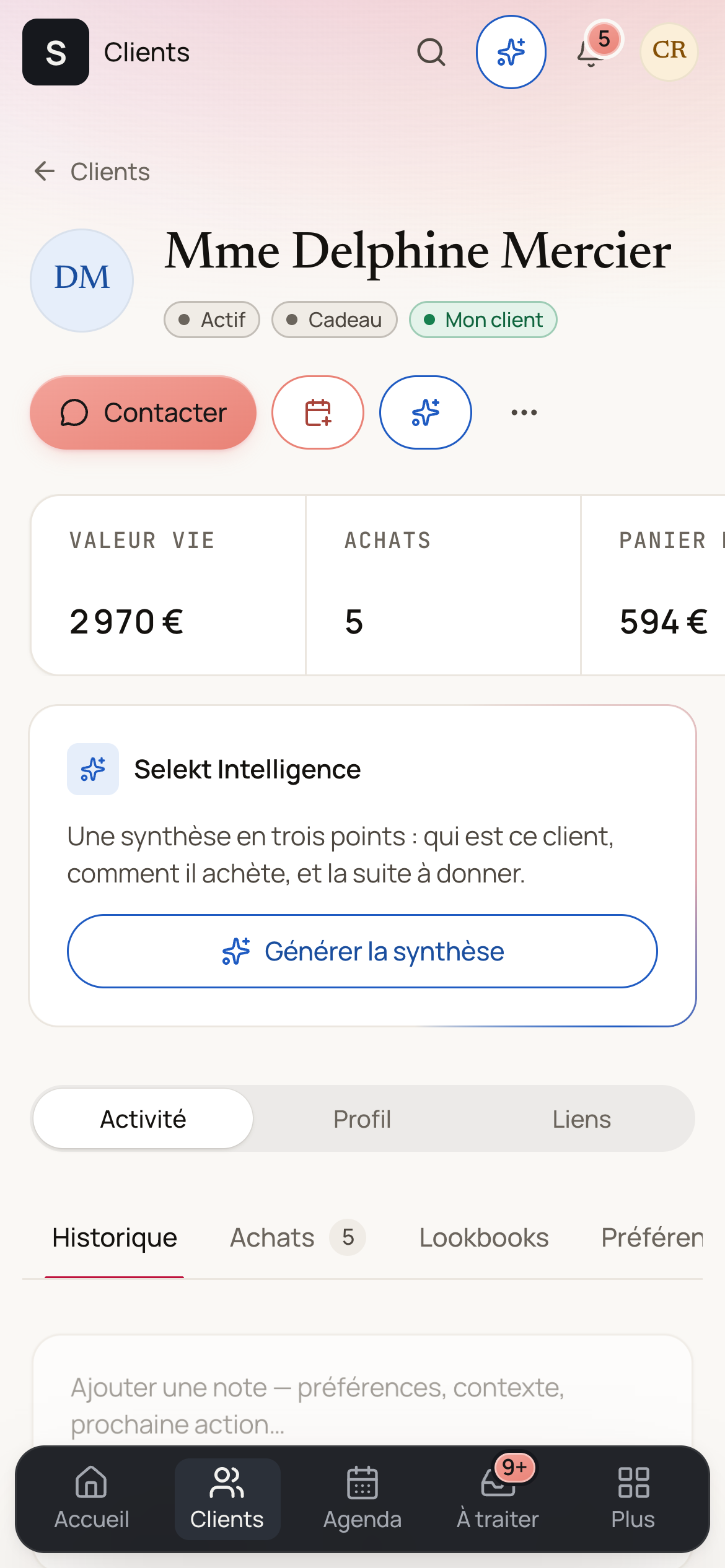
Selekt brings advisors, managers and headquarters into one clienteling application: full client profile fed by the POS, traced messages, appointments, catalogue with network stock, and sales attribution following your own rules.
- Mobile for the advisor, tablet for the manager, desktop for headquarters
- Influenced and direct revenue always distinct, never added together
- Attribution rules, fields and message templates configurable without a developer
Frequently asked questions.
Clienteling ROI calculator.
Discover your personalised revenue projections, based on the real performance of networks equipped with clienteling.
Your current metrics
Annual revenue
All channels combined, per year
€1,000,000
Average basket (AOV)
The average value of a sale
€600
Sales advisors
In store and remote
7
Number of clients
Active clients across all points of sale and online
100
Purchases / year
Per client per year
20








Request a demo
Discover Selekt directly with your use cases.
A guided demonstration, tailored to your boutique network.
- Thirty minutes
- No commitment
Page updated September 25, 2026