
The client returns in three years. Someone has to remember.
In jewelry and watches, visits are rare and baskets are high: everything is decided between two visits. Selekt sits above your jewelry store software to share out client books, follow up at the right moment, and measure what the relationship produces, store by store.
The relationship lives in the advisor's memory.
The personal notebook
Every advisor keeps one: sizes, preferences, dates. It works very well, for them, as long as they are there and as long as they remember.
If an advisor leaves the company
The store loses touch with their best clients. Those clients come back, are not recognised, and leave with the feeling of having become anonymous.
Twenty to thirty clients followed
That is what one advisor can hold from memory. Beyond that the file sleeps: those clients bought once, and nobody ever reached out again.
The full client file
It already sits in your retail software, with purchases and dates. Data is not what is missing — someone whose actual job is to use it, is.
The occasions do not come round again.
Nobody buys a diamond because they were walking past. They buy for a reason, on a date — and that date is usually known in advance.
What your software already does, what Selekt adds.
| Your retail software | Selekt | |
|---|---|---|
| Stock, pieces, inventory | ||
| Payment and accounting | ||
| Regulatory registers and tax | ||
| Client profile and purchase history | picked up and enriched | |
| Client books shared out per advisor | ||
| Traced, prepared follow-ups | ||
| Influenced revenue, measured per store |
Your software runs the store. Selekt brings the client back, and proves what that produced.
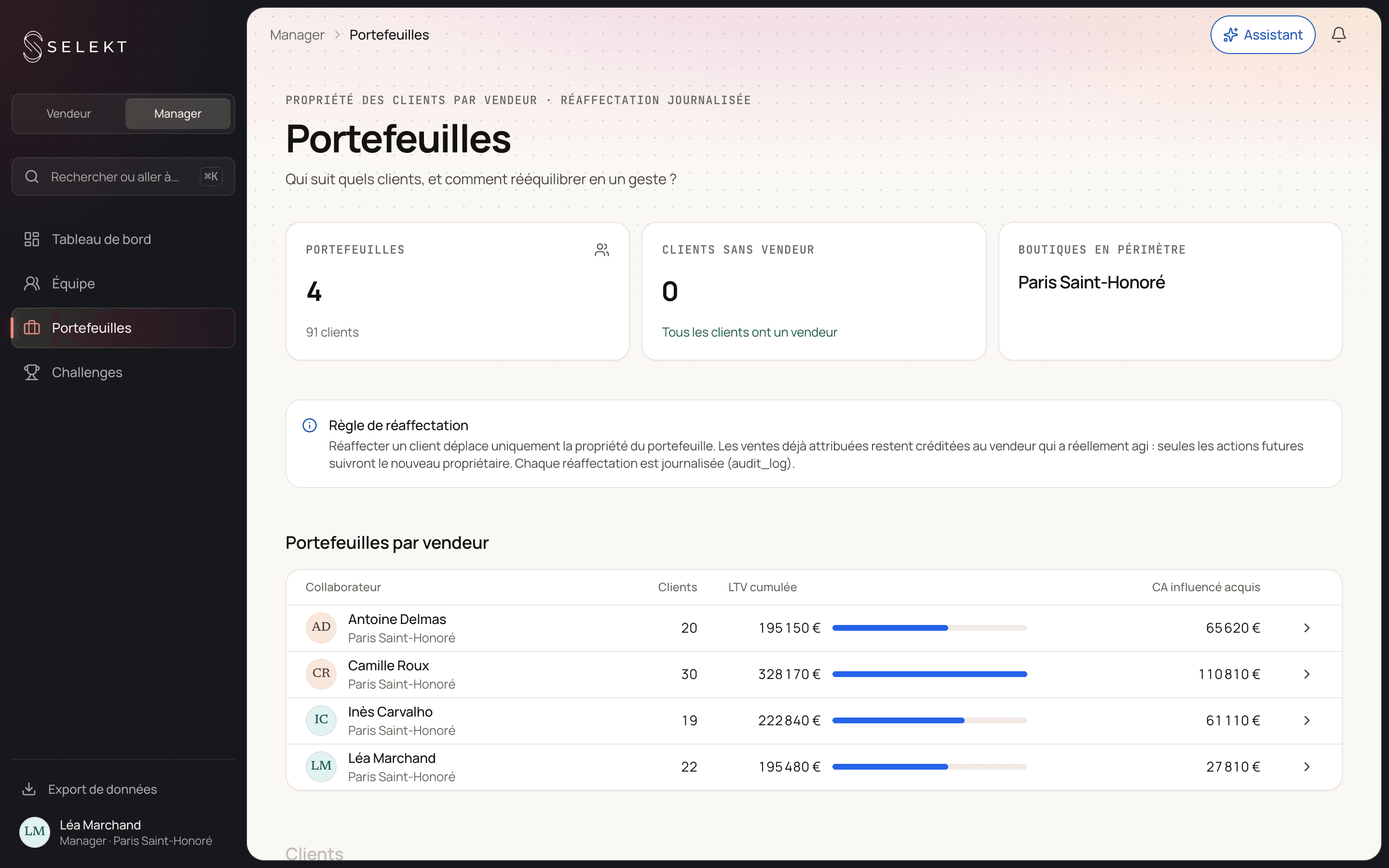
Sharing the client book between advisors.
A file everyone can see and nobody follows produces nothing. A client book puts a name against each client: someone whose job it is to know them and to reach out.
- Allocation follows your rules: who sold, who knows the client, who has capacity
- A client served by several advisors stays visible to all, with one person responsible
- When an advisor leaves, their book is reassigned with its full history
- The manager sees who was contacted, when, and who has been called by nobody
What brings a client back is the detail.
The measurements
Ring size, wrist size, neck size, chain length. The detail that turns browsing into a sale, because you already know the piece will fit.
Metals and constraints
Yellow or white gold, nickel allergies, preferred stones, engravings already done. These decide whether a selection lands or misses.
The piece seen in the window
A one-off or limited piece looked at but not bought: recorded, it becomes a reason to call before it goes.
Consignment and reservations
A piece on consignment, a reservation, a special order: each has a deadline, and every deadline is a legitimate reason to make contact.
The budget and the occasion ahead
An anniversary, a gift to offer: what the client is preparing tells you what to show, and above all when.
Repairs and servicing: a date known in advance.
Workshop flows are treated everywhere as logistics. They are in fact the most natural source of contact in the trade: the client is already expecting to hear from you.
The repair is ready
A message as soon as it returns from the workshop, signed by the advisor who took it in. The client comes back to the store, and the visit becomes another occasion.
Servicing due
A mechanical watch is serviced at known intervals. Reaching out before the date is a service; waiting for a failure sends the client somewhere else.
Warranty about to end
A few weeks before expiry, an offered check-up beats a generic letter. It is the moment to talk about care, straps and accessories again.
Special orders and waiting lists
In watches especially, waiting can last months. A regular update, even with no news, separates a patient client from a lost one.
Watches and fine jewelry: other rhythms.
The gestures are alike; the moments differ.
Reaching out without being intrusive.
The concern is legitimate: in jewelry, one message too many damages the relationship. The rule is simple — you do not make contact to sell, you make contact because there is a reason.
- A real reason: a piece reserved, a service due, a date that matters to the client
- The channel they chose, at the frequency the house has set for itself
- A message signed by their advisor, in the house's tone, never a mass promotion
- Human approval before anything is sent, including when the draft was prepared automatically
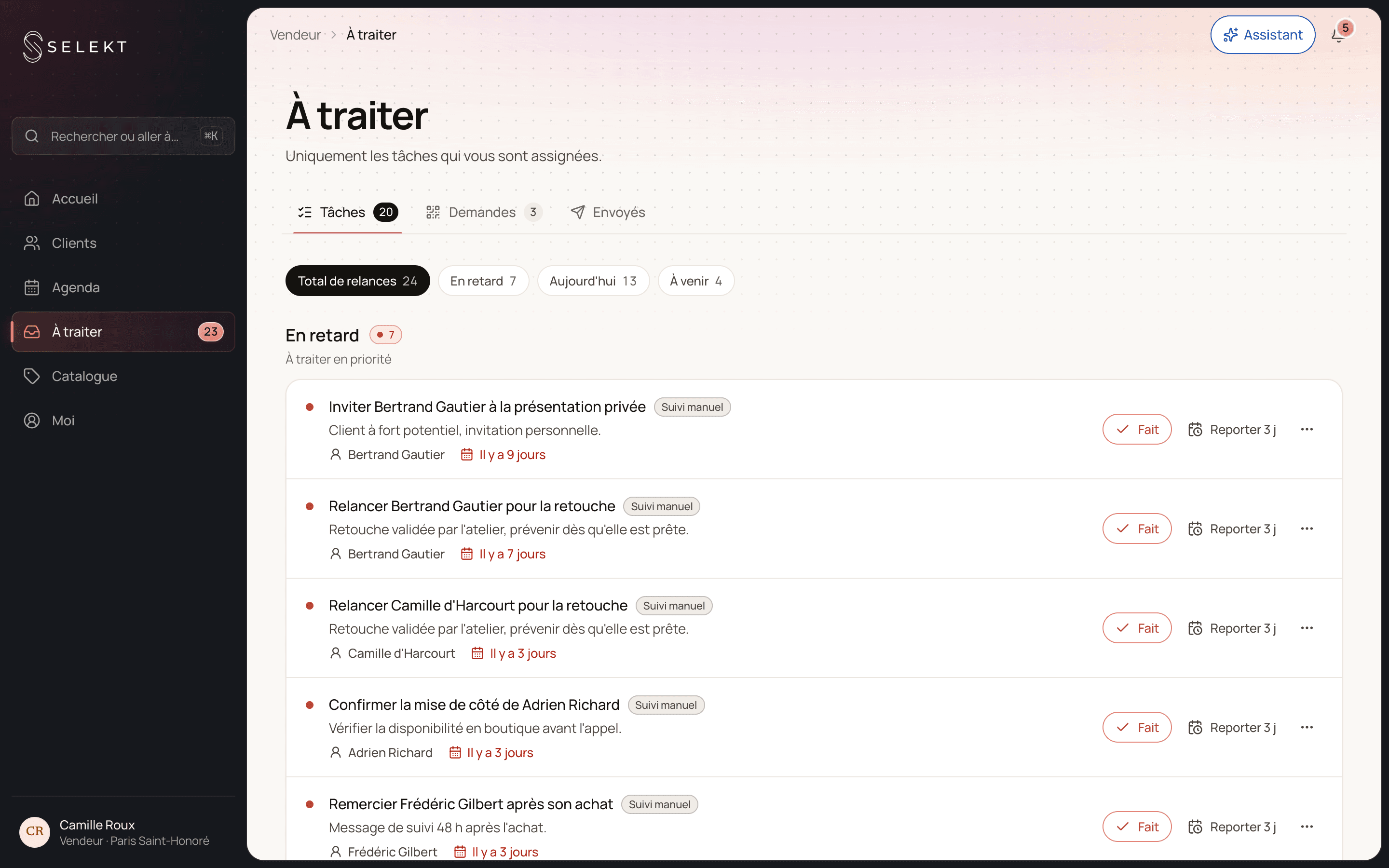
Measuring what the relationship produces.
01
Trace the action
Message, appointment, follow-up: timestamped and attributed to the advisor who made it.
02
Set the window
Seven, thirty or ninety days between contact and sale. You decide, and the rule is written down rather than hidden in a setting.
03
Attribute the sale
A sale within the window joins influenced revenue. It stays separate from walk-in sales and is never added to them.
04
Reconcile
Store by store, line by line, the amounts match the POS. Across equipped retailers, influenced revenue commonly represents 20 to 25 percent of total revenue.
What jewelry store software should include.
Criteria rather than brands. Most jewelers already own retail software; the question is what has to sit next to it for clients to come back.
It works with the software you already run.
Your point of sale and retail management
Purchase history flows in, so the client profile is readable on the floor and influenced revenue reconciles with the till. Your software keeps stock, payment, registers and tax.
Your e-commerce
An online order joins the profile of the client followed in store, so the advisor stops discovering after the fact what their client bought on the website.
Your messaging channels
Outreach leaves on the channel the client actually uses, and stays traced in the name of the house and of the advisor who sent it.
Anything else you run
Loyalty, review platforms, marketing tools, a bespoke in-house system: tell us what you use and we set the connection up with you, store by store.
What jewelers ask us.
Clienteling ROI calculator.
Discover your personalised revenue projections, based on the real performance of networks equipped with clienteling.
Your current metrics
Annual revenue
All channels combined, per year
€1,000,000
Average basket (AOV)
The average value of a sale
€600
Sales advisors
In store and remote
7
Number of clients
Active clients across all points of sale and online
100
Purchases / year
Per client per year
20








Request a demo
Discover Selekt directly with your use cases.
A guided demonstration, tailored to your boutique network.
- Thirty minutes
- No commitment
Page updated September 16, 2026