
One client record, across a network of stores.
In a network, the same client often exists four times over: once per store they have visited, once on the website, once in the till's customer file. A single customer view turns those records into one, kept properly and usable where the client actually shows up. This page explains what it is, where duplicates come from, and what one record changes for the person standing in front of the client.
A single customer view: what it actually is.
What it is
One record per person, built by matching the entries that refer to the same client, then made available to the tools that use it: the store, marketing, customer care, headquarters.
What it is not
Neither a warehouse where data piles up awaiting a purpose, nor a campaign tool. It sells nothing and sends nothing: it answers the prior question — is this the same person? — on which everything else depends.
Where duplicates come from
From the ordinary life of a network. A client pays without producing their loyalty card, orders online under a different address, has their name typed with a typo on a busy afternoon. None of this is a mistake: these are the real conditions of selling.
Who it serves
The advisor first, because they recognise a client a colleague served elsewhere. Marketing, so the same person is not contacted three times. Leadership, to count a client once and a sale once.
Where a client splits in two.
| What the network sees today | What one record changes | |
|---|---|---|
| They pay without giving their name | One more anonymous receipt, and a loyal client who appears nowhere | The payment, the name or the contact details attach the purchase to the existing record |
| They order online and collect in store | A web client and a store visit, counted as two people | One client, known to buy online and collect in person |
| They visit two stores in the network | Two partial histories, two advisors each believing they found them | One complete history, and a named person to follow up |
| Their name is typed two different ways | Two near-identical records nobody has time to merge | A proposed match, and a human decision whenever the case is doubtful |
| They buy tax free | A separate administrative file, disconnected from the relationship | A purchase attached to the right client, in the same history as the rest |
Every one of these lines happens in a network of two stores as much as fifty. It is not a question of size, it is a question of how many places the same client can appear without being recognised.
From a till entry to one record.
The principle is simple, and worth understanding before choosing anything: what separates a properly kept record base from an ordinary customer file is not the quantity of data, it is the rule applied to every new entry.
Data arrives from where it is created
A purchase at the till, an online order, a sign-up in store, an exchange with customer care. Nobody retypes anything: what is already recorded somewhere should not be recorded a second time.
Records are matched
Entries that plainly refer to the same person are brought together. On the platform, matching happens automatically; what matters to the brand is that the rule is the same everywhere and that it is written down.
Doubtful cases stay decidable
Two namesakes in the same city do not merge on their own. A serious record base can say « I don't know » and leave the decision to a person, rather than mixing two clients — the costliest error of all.
The rule is written once for the whole network
What counts as an active client, what counts as consent, what gets matched and what stays separate. Local variants make network figures impossible to compare, and that is what sinks these projects long before the technology does.
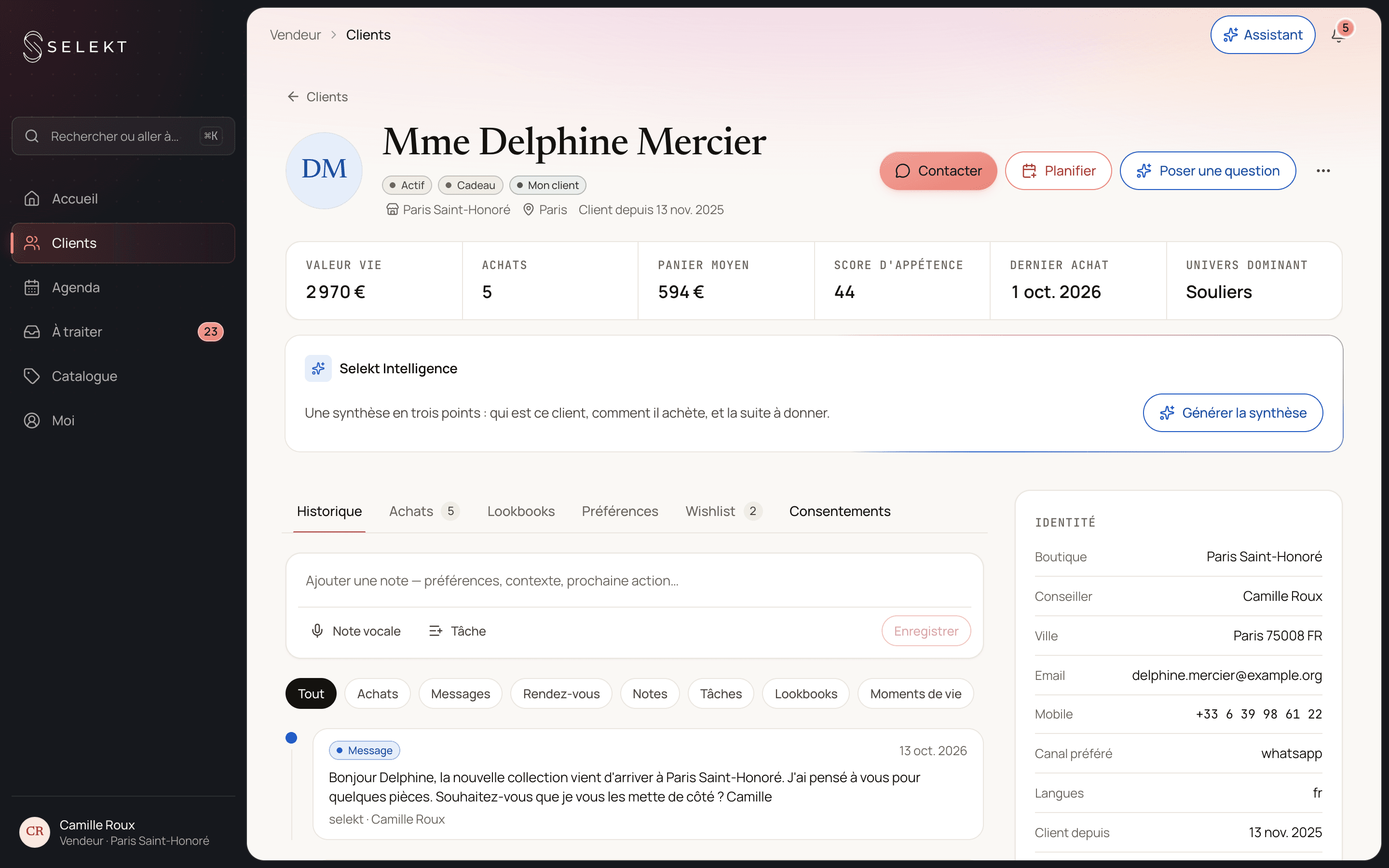
What it changes for the advisor.
This is the great absentee of the subject: of the ten French pages ranking on this topic today, one mentions the advisor and one mentions the till. The record base is described as a data project. Yet the person who benefits most immediately is the one greeting the client.
- They recognise a client a colleague served in another store, and serve them as if they knew them
- They do not ask again for a size, a preference or an address the house already holds
- They see a complete history rather than the quarter of it that happened in front of them
- They do not create a fourth duplicate by typing quickly on a busy day
What one record makes possible.
Following up without duplicating
A client who exists three times receives the same message three times, often on the same day. That is not merely inefficient: it is the kind of detail that undermines a house in front of its best clients.
Recognising a client in any store
Recognition is the very promise of high-end retail. It requires the information to follow the client, not the store where they first happened to walk in.
Assigning client books without overlap
Clients can only be assigned to advisors if each client exists once. Otherwise two advisors follow the same person, with two different histories and two contradictory messages.
Counting a client once
Active clients, purchase frequency, average basket: all of these are calculated on people, not on records. A file holding 40,000 records for 28,000 people is wrong about everything.
A sale counted once.
01
Trace the action
Message, appointment, follow-up: every gesture towards a client is timestamped and attributed to the person who made it. Without that trace nothing can be measured afterwards — and it only exists if the client is identified once.
02
Set the attribution window
Seven, thirty or ninety days between contact and sale. It is the brand's decision, written down and known to everyone, not a setting hidden in a tool.
03
Keep influenced revenue separate
A sale falling inside the window joins influenced revenue. It stays distinct from walk-in revenue and is never added to it: a sale counted twice discredits the whole measure, and the record base with it.
04
Reconcile against the till
Store by store, line by line. Across equipped retailers, influenced revenue commonly represents 20 to 25 percent of total revenue — an order of magnitude that means nothing while clients are still duplicated.
A client file kept properly.
01
Consent, collected and dated
Who agreed to be contacted, on which channel, and when. Consent belongs in the client record, not in a spreadsheet kept beside it.
02
Access and erasure rights
A deletion request has to run across the whole network. That is precisely what a single record base makes possible, and what a scattered file makes impractical.
03
Field-level permissions
An advisor sees their clients, a manager their store, headquarters the network. Bringing data together does not oblige anyone to open it to everyone.
04
An access log
Who read what, who changed what, when. It protects the house, and it settles internal debates better than a conversation does.
What connects to it.
A single customer view is built from what already exists and serves what comes next. It is never an isolated project.
Frequently asked questions.
Clienteling ROI calculator.
Discover your personalised revenue projections, based on the real performance of networks equipped with clienteling.
Your current metrics
Annual revenue
All channels combined, per year
€1,000,000
Average basket (AOV)
The average value of a sale
€600
Sales advisors
In store and remote
7
Number of clients
Active clients across all points of sale and online
100
Purchases / year
Per client per year
20








Request a demo
Discover Selekt directly with your use cases.
A guided demonstration, tailored to your boutique network.
- Thirty minutes
- No commitment
Page updated September 25, 2026