
Retail CRM, for networks of physical stores.
Most CRMs are designed for sales teams sitting at a desk. A store network works differently: the sale starts at the till, it plays out in a few minutes, and the client sometimes returns a year later. This page explains what a retail CRM is, what it does, and what it does not do.
What a retail CRM actually is.
What it is
A single client record, fed by the point of sale and the website, shared between stores and headquarters, and readable by the person greeting the client.
What it is not
Neither a point-of-sale system nor a campaign tool. It sells nothing and takes no payment: it holds the memory of the relationship and makes it usable.
Where the confusion comes from
In retail, the word CRM covers three very different families of software. That is the next section, and the reason two brands that both say they have a CRM often have nothing in common.
Who it serves
The advisor first, because the client is standing in front of them. The manager, to share out and follow up. Headquarters, for a coherent base and figures that reconcile.
The three tools called CRM in retail.
| Marketing CRM | POS customer file | Clienteling tool | |
|---|---|---|---|
| Who uses it | Marketing, headquarters | The till, sales administration | The advisor, on the shop floor |
| Unit of work | A segment, a campaign | A transaction | A client, a conversation |
| What it knows | How clients react to sends | What they bought | Purchases, preferences, what was said |
| What it misses | Everything said in store | Anything that is not a receipt | Nothing of the above, once connected |
| What it measures | Open and click rates | Revenue per store | Sales attributed to actions |
All three coexist well. What does not work is expecting from one what only another can do.
What a retail CRM does not do.
01
It does not take payment
The POS stays the POS: payment, stock, accounting, regulatory duties. A retail CRM connects to it and never replaces it.
02
It does not manage stock
It can show whether a piece is available elsewhere in the network, because that helps the advisor. It does not run ordering, replenishment or inventory.
03
It does not replace the advisor
It gives them memory and time. A brand whose teams have neither the time nor the authorization to contact their clients will get nothing from software.
04
It proves nothing on its own
Without a written attribution rule and sales flowing back from the POS, it produces activity dashboards. Useful, but not evidence of return.
What changes for the advisor.
This is what the pages on the subject leave out, and the advisor is the only person who will use the tool every single day.
- They recognise a client they have never served, and serve them as if they knew them
- They know what was said last time, and by whom
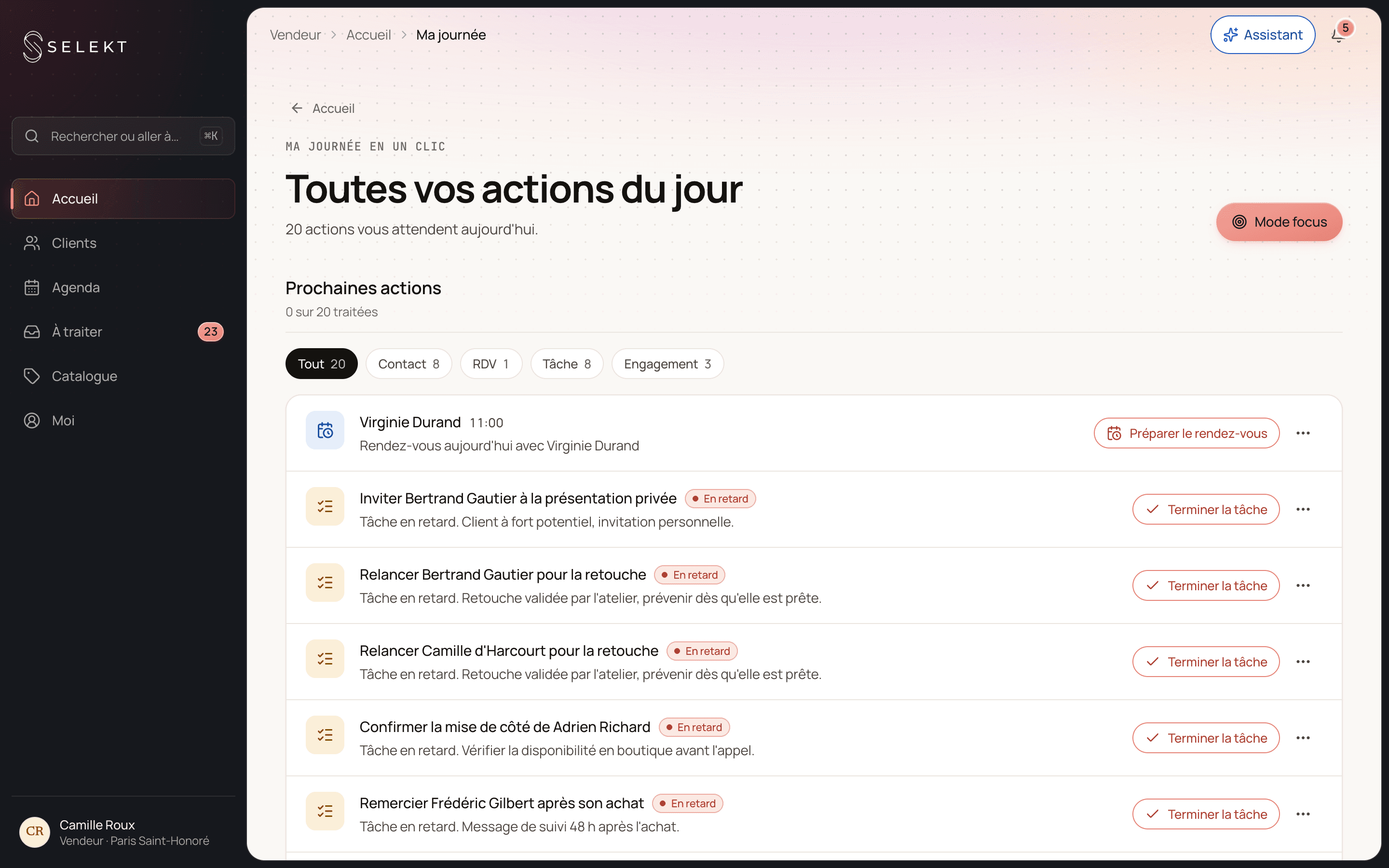
- They see the day's clients to contact, each with a reason
- They retype nothing: what the till records lands in the client record
One client, several stores.
A single client record
One record per person, whichever store they buy in and whichever channel they use. Without that reconciliation, everything downstream is wrong.
Assigned, visible client books
Who follows whom. A client with no named owner is a client nobody contacts; a client followed by two advisors receives two contradictory messages.
When an advisor leaves
Their book is reassigned with its history. The house keeps the relationship it paid for, and the client is not greeted as a stranger.
The same rules everywhere
One attribution window, one set of included channels, one definition of an active client. Local variants make network figures impossible to compare.
A sale counted once.
None of the eighteen competing pages we analysed describes this protocol. It is the only way to answer the question leadership actually asks: what does it return?
Trace the action
Message, appointment, follow-up: timestamped and attributed to the person who made it. Without that trace, nothing can be measured later.
Set the window
Seven, thirty or ninety days between contact and sale. It is the brand's decision, written down, not a setting hidden in a tool.
Attribute the sale
A sale within the window joins influenced revenue. It stays separate from walk-in sales and is never added to them: a sale counted twice discredits the whole measure.
Reconcile
Store by store, line by line, against the POS. Across equipped retailers, influenced revenue commonly represents 20 to 25 percent of total revenue.
A client file kept properly.
Consent, collected and dated
Who agreed to be contacted, on which channel, and when. Consent belongs in the client record, not in a spreadsheet kept beside it.
Access and erasure rights
A deletion request has to be executable across every store and channel, not only where the client happened to ask.
Field-level permissions
An advisor sees their clients, a manager their store, headquarters the network. Sensitive fields are restricted further, by role and by store.
An audit log
Who read what, who changed what, when. It protects the house, and it settles internal debates far better than a conversation does.
Connected to what you already run.
A retail CRM is only worth something once connected: without purchases flowing in, it is an address book.
Frequently asked questions.
Clienteling ROI calculator.
Discover your personalised revenue projections, based on the real performance of networks equipped with clienteling.
Your current metrics
Annual revenue
All channels combined, per year
€1,000,000
Average basket (AOV)
The average value of a sale
€600
Sales advisors
In store and remote
7
Number of clients
Active clients across all points of sale and online
100
Purchases / year
Per client per year
20








Request a demo
Discover Selekt directly with your use cases.
A guided demonstration, tailored to your boutique network.
- Thirty minutes
- No commitment
Page updated September 25, 2026